
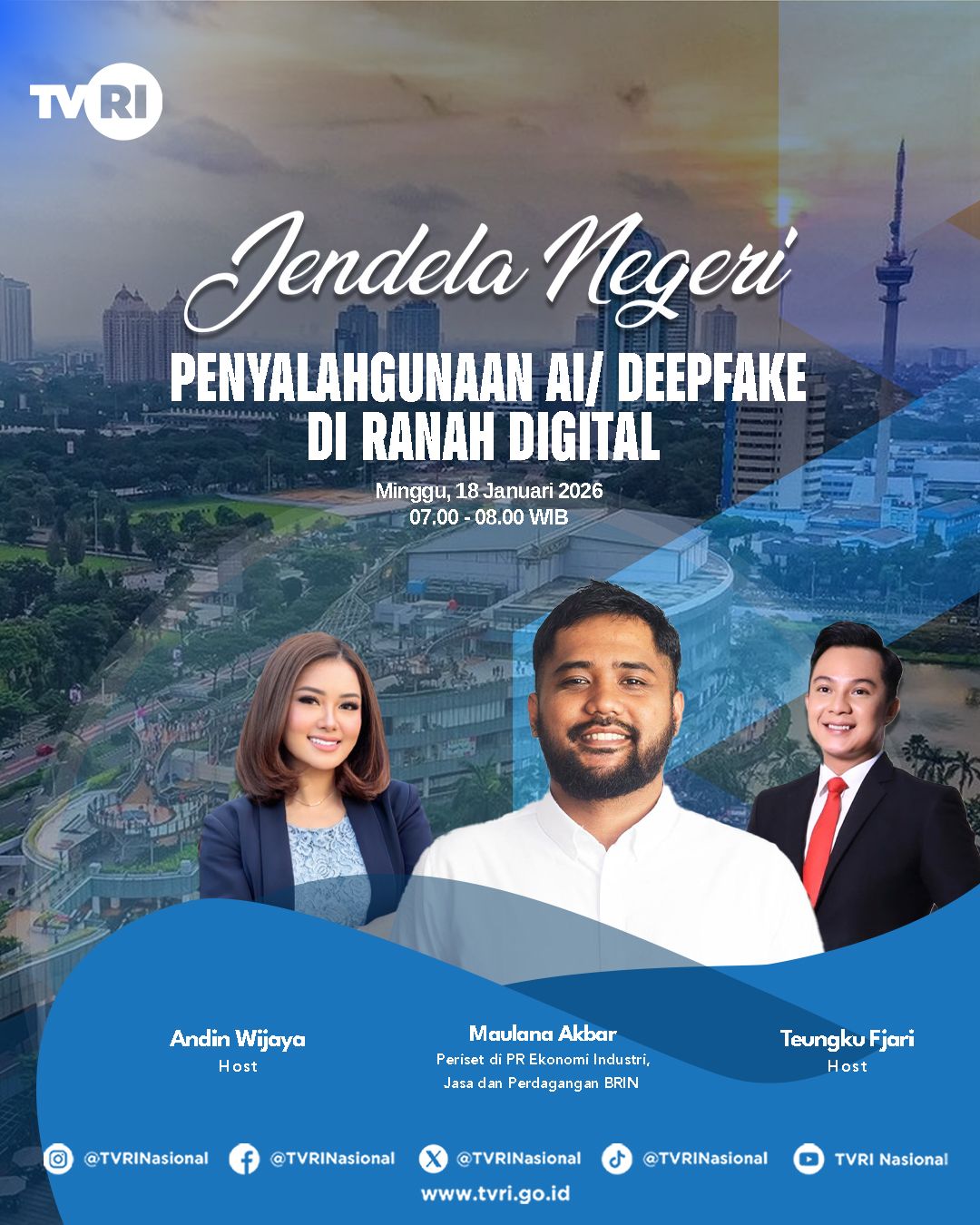
This Sunday morning, I had the pleasure of joining hosts Teungku Fajri and Andien Wijaya at the TVRI Studio for a live segment of Jendela Negeri. The atmosphere was surprisingly bright despite the unpredictable Jakarta weather, and we dove straight into one of the most pressing issues of 2026: the rise of Artificial Intelligence (AI) and the growing threat of deepfakes in Indonesia. As a researcher at BRIN, I’ve seen these technologies evolve at breakneck speed, but discussing their real-world impact on a national platform always brings a new layer of urgency to the work.

We started the conversation by tracing the roots of deepfakes back to 2017. It’s fascinating—and a bit terrifying—how a technology that began in niche online forums has become a household name by 2024, especially after its heavy use during the recent elections. I described AI and deepfakes as a double-edged sword. On one hand, they offer incredible productivity boosts for our creative industries; on the other, they are being weaponized for financial fraud, identity manipulation, and—most distressingly—non-consensual content that largely targets women and children.
The Reality of the Digital “Wild West”
A significant portion of our discussion focused on why Indonesia is currently so vulnerable. While we have regulations like the PDP (Personal Data Protection) Law and the ITE Law, the technology is moving much faster than our policy frameworks. I highlighted several key risks that keep me up at night:
- The Erosion of Truth: We are moving into an era of “Zero Trust.” We used to view photos and videos as objective facts, but deepfakes have blurred that line. Today, an authentic video can be dismissed as “AI-generated,” while a fake can be swallowed as truth.
- Economic Impact: Beyond the immediate fraud, deepfakes threaten the stability of our digital economy. If investors and the public lose faith in the integrity of digital platforms, the growth of our e-commerce and fintech sectors could stall.
- Social Vulnerability: Reports from Bandung and Central Kalimantan during the show echoed a common theme: our digital literacy isn’t keeping pace. We are teaching people how to use tools (digital skills), but we aren’t teaching them how to behave (digital ethics).
Moving Toward a Safer Digital Future
So, where do we go from here? I shared with the viewers that the solution isn’t just about more technology or stricter blocking—it’s about a multi-stakeholder collaboration. We need the government to synchronize regulations, platforms to implement “Safety by Design” (like mandatory AI labeling), and the research community to provide better detection tools.
However, the most immediate “shield” we have is much closer to home. I emphasized the importance of “Saring sebelum Sharing” (filter before sharing). We must cultivate a culture of critical thinking within our families and schools. Before our children learn how to prompt an AI, they need to understand the ethical boundaries of the digital world. It was a refreshing morning at TVRI, and I left the studio more convinced than ever that while AI is unstoppable, our human capacity for ethics and empathy is what will ultimately keep us safe.
Leave a Reply